Search
  Client portals
  020 3727 6666

Events in Iran and the wider Middle East have once again brought fast moving headlines and understandable concern. Many people will have seen the weekend coverage, and our thoughts remain with those directly affected. Moments like this remind us that behind every market reaction sits a very human story.
While the news flow can feel intense, our job is to help you make sense of what is happening and what it means for your long term plans.
How we’re positioned right now
Your 7IM portfolios remain broadly neutral in risk and intentionally diversified across different regions and types of investments. This helps smooth the impact of sudden geopolitical events.
We also hold near zero direct equity or emerging market bond exposure to Iran or Israel. For context, global indices such as the MSCI World carry only a very small weighting to Israel (around 0.06%, even within higher risk strategies). This limits any direct effects from the conflict on your 7IM portfolio.
We’re watching over developments
Right now, there’s no need to adjust our positioning, but we’re closely following developments.
We review market data each day and check how our research and models interpret the latest information. These tools help guide our thinking – though they don’t remove uncertainty or predict outcomes – and we’ll stay ready to act if conditions change.
How the markets reacted
Since the weekend, markets have been reacting to the latest information.
Equities have moved lower in the UK, US, Europe and Asia, as a result of initial uncertainty, combined with the worries of higher energy costs. Almost all of Iran’s oil is sold to China.
The big move has been in the oil price, which at time of writing, is over $80 dollars a barrel.
The Middle East is a vital part of global energy and shipping routes – including the Strait of Hormuz in Iran – so tensions often lead to quick reactions in oil markets. Even so, the rise sits within the range we’ve seen over recent years.
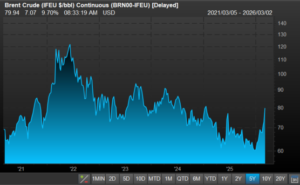 Source: FactSet
Why energy prices matter
If higher oil prices persist, they can influence inflation. And if inflation remains sticky, this may affect:
- The timing of interest rate cuts
- How government bonds behave in periods of stress
This is one reason we use a broad mix of assets, not just bonds, to help manage risk more effectively across changing conditions.
Putting today’s events in a longer term context
Market reactions to geopolitical events can feel worrying in the moment, but history tells a fuller story. Many past conflicts have not led to long lasting market declines, and global markets have often stabilised within months.
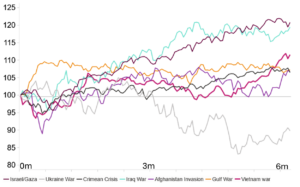
Source: FactSet. Performance of the MSCI AC World in USD.
Every situation is different, of course, and past performance is not a guide to future results – but looking at the bigger picture helps keep short term events in perspective.
We’re here if you’d like to talk things through
Unsettling news can sometimes raise questions about your long term plans. If there’s anything you’d like to discuss – or if you simply want to understand more about what we’re watching – please do speak to your adviser. We’re here to help you stay in the loop.
Important information
This communication is for general information only and does not constitute advice on investments, taxation, legal matters or any other area. Past performance is not a guide to future results.