Search
  Client portals
  020 3727 6666

It has now been just over a week since the US and Israel launched military action against Iran. For many people with family or personal ties to the Middle East, the news feels unsettling and close to home. And for all of us, the headlines can be overwhelming.
Anyone hoping for a quick breakthrough over the weekend will have been disappointed. Both sides appear willing to continue military operations. While the conflict hasn’t widened dramatically, the closure of the Strait of Hormuz has halted key energy shipments – and that’s having a clear impact on markets.
This morning (9 March), Brent crude oil rose above $100 per barrel. Equity markets opened lower again, with Japan and South Korea feeling the sharpest pressure due to their dependence on imported oil.
There’s already speculation about the global economic outlook, and the International Energy Agency has confirmed it is reviewing the possibility of releasing emergency oil reserves. It’s easy to see how this environment could pull investors into a spiral of worry.
But as history shows, conditions can change quickly. A ceasefire, renewed access through the strait, or coordinated action on reserves could stabilise things faster than many expect. We expect market swings to continue this week, but this is not a moment for panic.
What’s happening within portfolios
Periods like this underline the importance of having a welldiversified portfolio. Shortterm headlines can be dramatic, but longterm strategy is what matters most.
At Amicus, we use small tactical adjustments within some portfolios to help manage risk and return. Last week, we made a modest increase to energy exposure and reduced weightings in communication services (including names such as Meta and Alphabet).
We haven’t changed the overall equity exposure. For a meaningful buying opportunity to emerge from a geopolitical shock, markets generally need to fall far enough that the lower prices justify the risk of further disruption. Our view is that markets haven’t reached that point, and there remains uncertainty around how long energy shipments may be restricted.
US equities have been the most resilient so far – helped by the US’s lower reliance on Middle Eastern energy and the recent strength of the US dollar, which has softened some of the declines for sterling-based investors.
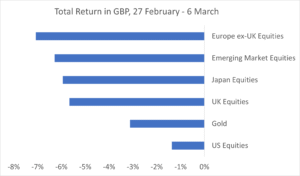
*Source: FactSet. Data is the total return in GBP for major equity indices.
Are higher costs coming?
Markets react most strongly when events affect economic growth, inflation or interest rates. Higher energy costs – if sustained – can influence all three.
We’re already seeing some early signs:
- Several UK energy providers have withdrawn fixed rate tariffs
- A number of banks have increased mortgage rates
- UK Gilt yields rose last week, reflecting concerns that inflation may remain higher for longer
Energy prices have also moved sharply, though it depends on when and where the energy is needed. Futures markets for oil and natural gas show steep rises for nearterm contracts (March and April), but more modest moves for later in 2026.
This suggests that the market expects the disruption to be temporary rather than long-lasting.
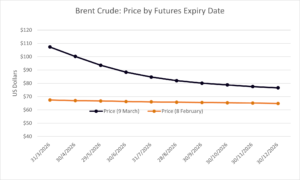
*Source: FactSet. 9 March 2026 prices are as of 8:30am GMT.
The path to resolution
Ending this conflict will require cooperation– and unlike the tariff-driven market volatility of 2025, no single decision-maker can change the situation overnight.
Even if the US were to pause military action, restoring safe passage for energy shipments will take time. How long the conflict lasts depends on both the willingness and capability of each party to continue.
There are some indications it may not be prolonged, but nothing is guaranteed. Domestic political pressures in the US, and the extent of Iran’s missile supply, will all play a part. Keeping the Strait of Hormuz closed is also unlikely to be a sustainable strategy for Iran in the long run.
Our view: stay invested, stay diversified
Geopolitical events can be uncomfortable, especially when the news cycle is intense. But the core principles of investing don’t change:
- Markets often recover before headlines improve
- Missing those early turning points can be costly
- A diversified, longterm plan remains the strongest defence against short term uncertainty
If you have any questions or would like to talk about your portfolio, we’re here for you.
This communication is for general information purposes and does not constitute advice on investments, legal matters, taxation or any other matters. Past performance is not a guide to future returns or results.